Please email questions to: education@orthosports.com.au
Dr Doron Sher
QUESTION | What is Enthesis augmentation in rotator cuff repair?
ANSWER |
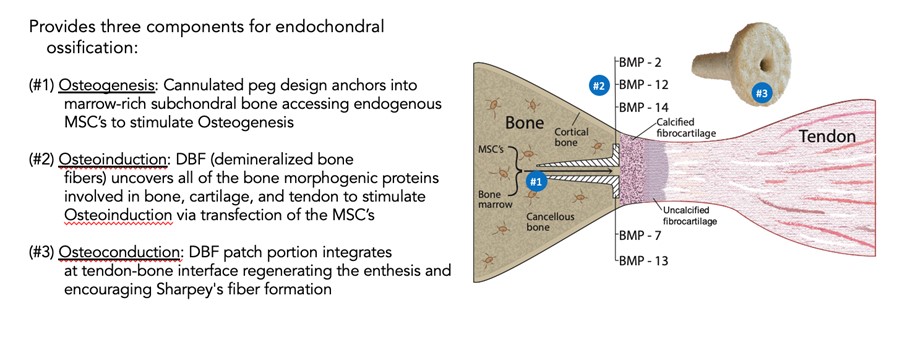
Despite major advances in technology the retear rate of the rotator cuff following repair is higher than we would like it to be. Until now the focus has been on reinforcing or thickening the tendon with various types of patches but recently the emphasis has changed to biological enhancement instead. This is designed to recreate the original tendon-bone interface of Sharpey’s fibres rather than healing with weak scar tissue.
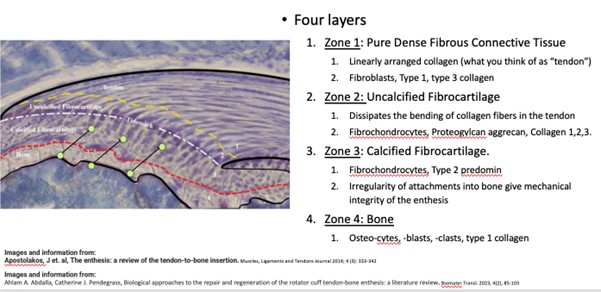
The rotator cuff attaches to bone in four layers as seen below. Unfortunately tendon does not heal very well to bone in a natural enthesis. Instead you end up with Fibrovascular scar formation which is more likely to fail in the future.
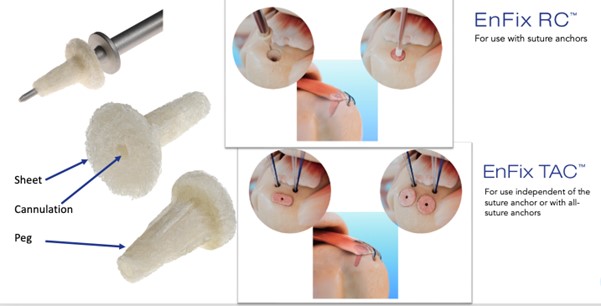
One of the solutions to the problem which is under clinical review at the moment is to augment the enthesis with an allograft bone plug. This provides osteogenesis, osteinduction and osteoconduction to the area to promote healing with Sharpey’s fibres and formation of normal tendon.
The product can be used to augment the bone and place the anchor into it to provide better fixation, or can be used between anchors to provide a biological enhancement of the repair.
The animal studies show that it improves both short and long term fixation outcomes and the early human clinical trials are showing a lower retear rate compared to patients that have not had the implant used.
The type of fixation used does not seem to matter very much when it comes to healing of the tendon and both single and double row repairs show good clinical outcomes. The goal is to reduce micromotion at the repair site during healing because excessive strain can disrupt fibrocartilage formation. This generally means doing absolutely no physiotherapy exercises in the first 6 weeks post surgery.
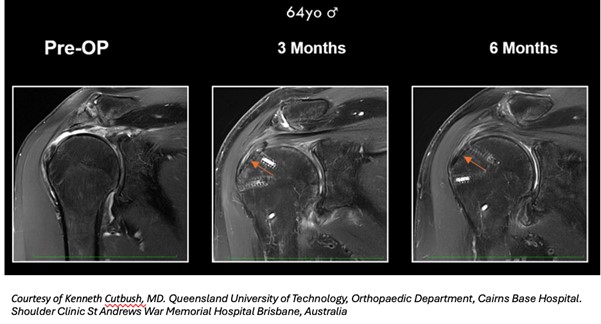
The images below show an example of the healing of the rotator cuff with use of the Tetrous product but even a biologically enhanced repair can fail if:
loading progresses too aggressively
scapular mechanics are poor
stiffness develops
strength deficits persist
So surgery and rehab remain tightly linked.
While it is still early in the clinical trial the results have been extremely encouraging. There are virtually no contra-indications to using the product and if the ongoing results are as good as the early results this will become a routine part of every rotator cuff operation moving forward.